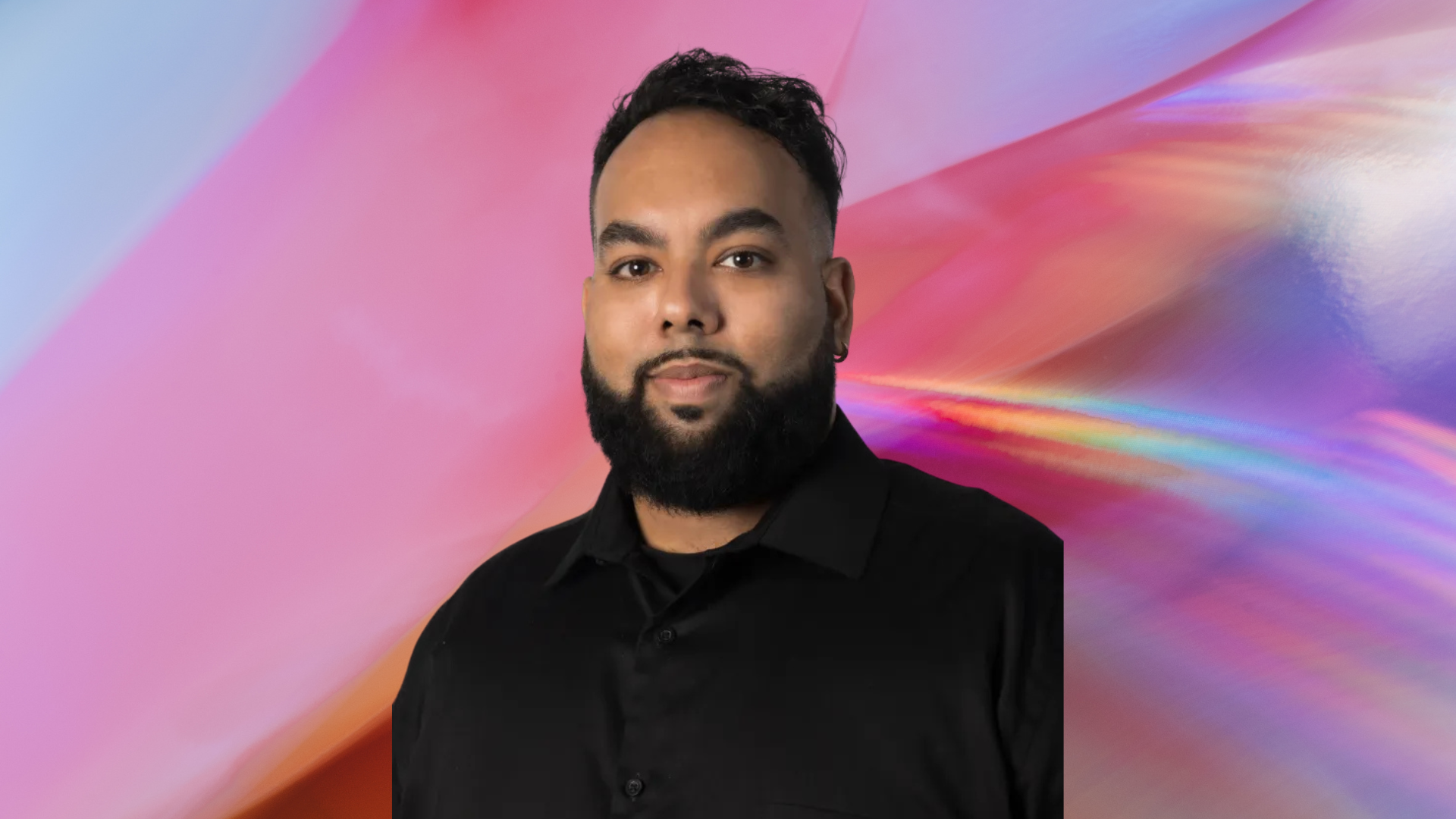
Designing the Future, One Hat at a Time
Interview with Demetri Ramlogan
From multimedia design to motion graphics and Caribbean-infused creativity, Demetri Ramlogan’s work defies category. Fresh off completing his degree, Demetri talks to me about creative curiosity, cultural mashups, and why ideas are like hats—you have to know when to switch them out.
Suneel Mistry: Demetri, congrats on wrapping up your degree. How does it feel to finally close that chapter?
Demetri Ramlogan: Honestly? Like taking a breath after holding it for years. I’ve been underwater this whole time, just swimming toward the finish line, and now, finally, I’ve surfaced. I started back in 2012 studying criminology and justice systems, but pivoted over the years. I tried Centennial College’s graphic design program, but it felt too print-focused for what I wanted. Then I found Humber’s Multimedia Design & Development program. That was it: UI/UX, audio, video, coding—just a mix of everything I love. That kind of versatility mirrors how I live, whether I’m DJing, working on my car, or experimenting in the kitchen.
Suneel: So, as you look to launch your portfolio and start entering the workforce, what skills or approaches are top of mind?
Demetri: For sure, people skills. You and I go way back to EB Games, and that job broke me out of my shell. I learned how to talk to anyone. Communication, collaboration, adaptability—that’s the real skillset. And staying current. With AI evolving so fast, it’s about being comfortable experimenting and accepting imperfections. Feedback, iteration, experimentation—repeat.
Suneel: Speaking of identity and adaptability, you’ve got Caribbean roots and grew up in Scarborough. How does that cultural blend influence your creative work?
Demetri: Cultural identity is huge for me. But mine came in layers. I wasn’t raised with soca or reggae from day one—I was into punk rock and MuchMusic growing up. It wasn’t until around grade two or three that I started connecting with Indo-Caribbean and Afro-Caribbean music and culture. Kevin Lyttle’s “Turn Me On” was a turning point.
When designing, I try to be intentional about whether I’m speaking to a local or global audience. Sometimes, going “global” can water things down. Authenticity lives in the local. Take my “Scarbro” shirt—there’s pride in that. You can scale global campaigns later, but if you lose the cultural truth in your work, it won’t resonate.
Suneel: That third-culture identity defines cities like Toronto. It’s not just Canadian—it’s its own thing.
Demetri: Exactly. Toronto’s a giant cook-up rice. You’ve got Caribbean rum, Sri Lankan short eats, Vietnamese coffee, and German hot dogs all in the same meal. It’s wild. I mean, in Guyana, people don’t even mess with sushi, even though it’s coastal. That blew my mind.
Suneel: It’s a different kind of mix down here—older, more embedded. But that blend up in Toronto feels constantly evolving. Speaking of evolution, what design trends are catching your eye?
Demetri: Depth. Things like Gaussian blur, iris blur, tilt-shift—it’s all about creating layers. Flat design still has its place, but depth allows more play, especially when you’re animating or adding motion. That spatial storytelling opens up a lot.
Suneel: Have you started looking into Unreal Engine or immersive tools?
Demetri: Yeah! I’m planning to take a couple of weekend workshops at Vancouver Film School. I want to expand beyond the basics. I’ve already been working with MadMapper, which lets you map video projections onto physical spaces. Imagine projecting Super Smash Bros. onto a wall, and masking it so characters jump over a real backpack. It’s wild.
Another tool I used is 8th Wall by Niantic. I created an AR experience where scanning a QR code opens a digital portal into the Caribbean—complete with soca music, a virtual rum hut, and dolphins swimming around you. It was part of a class project, but when I posted it on LinkedIn, people messaged me saying it felt like they were home again. That kind of feedback was everything.
Suneel: That’s a whole vibe. I remember walking around the office with it—people were like, “What are you doing?” But once they saw it, they were hooked.
Demetri: Right? Now, imagine placing a random door in a busy airport. Add a sign: “Scan me.” Suddenly, you’re walking into a digital version of St. Lucia or Guyana. With glasses like Ray-Bans x Meta, it could be even more immersive. Tourism marketing, cultural storytelling, nonprofit education—it’s all fair game.
Suneel: Speaking of marketing, what are your tips or philosophies heading into 2025?
Demetri: Dream big. Ridiculously big. Then scale it down. Like, if you think “Let’s send cheese to the moon to promote Dairy Ontario,” do it. Then figure out the grounded version—like an animated short of someone lassoing the moon and taking a bite. You want ideas that feel like a stretch and then bring them back to earth. No idea is bad unless there’s no rationale behind it.
Suneel: Yes. Corporate teams often get stuck in the “realistic,” but someone has to push the envelope.
Demetri: That’s why I like wearing multiple hats. I’ll switch from designer to marketer to audio editor to mixtape curator—all in the same project. Even in my 9–5, which is in finance, I focus on creating experiences that leave people smiling after they hang up. Nostalgia is a big part of that. It’s like the strongest currency after money—everyone’s trying to recapture a feeling.
Suneel: Yeah. And you’re good at noticing the world around you—like taking inspiration from buildings, cars, even food presentation.
Demetri: 100%. I’m always snapping pics, jotting down ideas. One artist I admire is Bunji Garlin. I heard he keeps a mini studio in his car—keyboard, laptop, everything. If inspiration hits on the road, he pulls over and gets to work. That hustle to capture inspiration in the moment—that’s powerful.
Suneel: So what’s next for you?
Demetri: Right now, I’m rebuilding my portfolio and resume—something bold, something that reflects me. I want it to feel like stepping into a space that’s part motion studio, part DJ booth, part Caribbean art gallery. I’m also reminding myself that I’ve been doing this for over a decade. I’ve got work and experience, even if it wasn’t always formal. So I’m going through everything I’ve done, organizing it into case studies, telling those stories.
Suneel: You’re doing the work. I know your portfolio’s gonna be something special. Any final thoughts?
Demetri: Just that I’m excited. I’m volunteering at my internship, soaking up everything I can, especially with events like Toronto Carnival coming up. There’s so much happening in the city. I want to keep learning, building, contributing—just keep moving forward.






No Comments